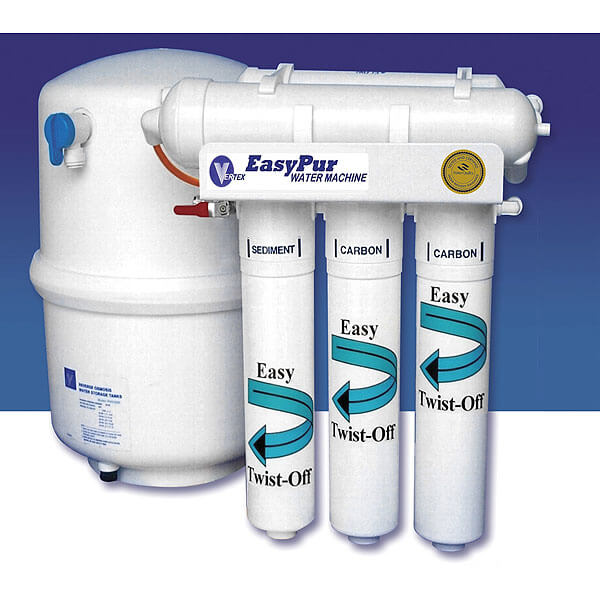

The EasyPur 75 Gallon Per Day RO Water Purifier has been specifically designed with premium features, including 5 stages of filtration. 5 Year Limited Warranty.
The EasyPur Reverse Osmosis Water Purifier features simple to use, twist-off cartridges that make filter changes a breeze. The encapsulated RO (reverse osmosis) membrane and post-filter are designed to make installation quick, easy, and sanitary. With 5 stages of filtration, the EasyPur Reverse Osmosis water purifier ensures premium water taste and quality. All critical filter components, RO membrane, tank, fittings, and tubing are NSF approved. The EasyPur comes complete, ready to install with connection hardware, tubing, faucet, and instruction manual.
5 Stages of Filtration in the EasyPur Reverse Osmosis Water Purifier
- Stage 1 - Sediment Filter, 5-micron polyspun cartridge - The 5-micron polyspun filter takes out suspended solids such as dirt, rust, sand, and pipe scale.
- Stages 2 & 3 - Granular Activated Carbon Filter, 5-micron - Twin activated carbon filters remove chlorine, bad tastes, and odors.
- Stage 4 - 75 GPD Reverse Osmosis Membrane - 75 GPD, TFC@65 PSI Pressure Differential - Reverse Osmosis filtration cleans water by taking out the totally dissolved solids (TDS) which contaminate the water. Although city water treatment removes the dirt and debris and adds chlorine to prevent the spread of diseases, it does not remove the dissolved solids from the water. And with the increasing pollution of our surface and ground water with contaminants such as lead, mercury, and chromium-6, as well as the naturally occurring harmful contaminants such as arsenic, fluorides, and sulfides found in some areas of the country, it is more important than ever to have a way to remove these contaminants at the point of use.
- Stage 5 - Granular Activated Carbon post-filter - When the faucet is opened, clean water from the storage tank flows through the final polishing filter of activated carbon and into the faucet for your use.
About Reverse Osmosis
Osmosis is a naturally occurring process in human and animal membranes. Salts in the body fluids build up osmotic pressure, forcing water molecules through the living membranes in our bodies. In under-sink reverse osmosis systems, pressure from the city water overcomes the "salt" pressure of the dissolved materials and forces the water molecules through a synthetic thin film membrane, leaving the dissolved salts behind. The city water enters the membrane filter element, and two streams leave; the clean water and the water containing the dissolved solid residue, called brine, which is discarded to the drain. On the comparative chart below, reverse osmosis removes the smallest of materials, from 1-micron down to 1- Angstrom. For materials larger than 1-micron, particle filters are used ahead of the RO membrane to prevent plugging of the tiny membrane pores.